Sleeping off a bender, I awoke to our mother hollering, “Time for school, find something pink to wear!” Like they wouldn’t anyway. Ninety percent of Misses P and V’s wardrobe is pink, but the exhortation to dress for anti-bullying day got them moving, which was Mum’s cynical intention. Usually she has to beg the kids a dozen times to don clothes for school, but in this case she could invoke novelty—or at least the idea of novelty.
 For boy children, dressing in pink might have been novel. Most boys don’t have a stitch of pink in their closets, either because they learn early that pink is a “girl’s color” or worse—because their parents shun pink on their behalf, fearing its possible potential to confer homosexuality on their male offspring. But bring on Anti-Bullying Day, and boys are expected to strut their pink threads.
My mum was relieved she didn’t have to purchase pink duds for a male child and/or bully said son into wearing them. Yes, Anti-Bullying Day is an excellent idea, but its execution is inevitably imperfect.
Girls typically wear pink; boys typically don’t. Therefore a “wear pink” campaign puts only boys out of their comfort zone. But of course that’s not the point—pink wasn’t chosen to single out boys. It wasn’t even chosen arbitrarily; it was prompted by an incident in which a male ninth grade student was bullied for wearing a pink shirt during the first day of school. The point isn’t to make kids uncomfortable; it’s to make them think. Which is great.
But whereas it’s not much of a stretch for girls to put on a pink shirt, just ask any parents who tried to wrestle their boys into pink this morning without success, and it’s a whole other story. As one of them commented to my mum, “My boys aren’t bullies. Most kids aren’t bullies. Wearing pink feels like a punishment to them.”
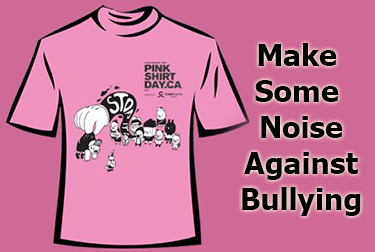 Okay, so bad on society for gendering the color pink. That’s something to chip away at, for sure. And over the years, Anti-Bullying Day may well help with that. But for now, many boys—especially young ones—don’t “get” Pink Shirt Day. All their lives they’ve learned that pink is for girls. (One day we even witnessed a dad in Toys R Us heatedly refusing to allow his two-year-old son to try a pink bike.)
Moreover, those pink shirts parents bought their sons for Anti-Bullying Day won’t see the light of day until next year, reinforcing the notion that pink is not ordinarily for boys.
“How many boys in your class wore pink today?” I asked P after she’d trussed me up in a pink dress for the occasion.
“Um, zero,” she said. “But J wore a pink armband and W clipped a piece of pink paper to his shirt.”
“Good for them.”
If anything this illustrates the nascence of Anti-Bullying Day. Inaugurated in BC in 2008, the event has only just recently locked into February 27 as its official day. Depending on the proactivity of schools and teachers, it could well gain traction over the next years and decades. For now it’s in its awkward infancy, still seeking across-the-board buy-in.

Bullying is bad. This sort of thing really shouldn’t happen.
But again, if wearing pink is the signature outward emblem of participation in Anti-Bullying Day—ignoring for the moment how stupidly arbitrary it is to equate pink with femininity—are we not asking more from boys than from girls when we urge “all” kids to wear a pink shirt? P and V most likely would have done so anyway, but their male cohort would not have, which makes the exercise unfair—at least until we actually do chip away at the pink-for-girls and blue-for-boys stereotypes that underpin the bullying incident that kicked the whole idea off.
Lastly, we shouldn’t forget that bullying is not the sole domain of boys. Small percentages of both genders dish out intimidation and physical violence (just ask V, who has a female five-year-old tormenter). If wearing pink demands no effort of girls and considerable effort of boys, is the underlying message that girls are exempt from bullying?
Obviously the answer is no—it’s not the intentional message. But it is a message that could accidentally be inferred. Although schools do a good job of explaining Anti-Bullying Day and emphasizing that no one gender has a monopoly on abusive behavior, the anti-bullying message is riding on a raft of socially constructed implications—much the way gay-rights issues sometimes get swept along with rainbow themes that don’t necessarily resonate with all gay people. Hitching your wagon to a color or spectrum of colors is a great way to get attention and promote a cause, but in our society colors are laden with value assumptions that sometimes muddy the message.
 Bottom line at LBHQ: We don’t mind pink; three-quarters of the humans wear it all the time. When P draped me in my pink frock today I did get the impression she was trying to make me look prettier. Or maybe she was making a political statement—who knows?
The real bottom line is that Anti-Bullying Day, no matter how it’s observed, is important. It’s important enough to warrant a “theme drink” such as this mouth-watering Pink Lady. But then of course we’d have to worry about what such a drink implied.

Oh damn it, let’s just buy the gin anyway and make one.


 Liquorstore Bear