CALONA VINEYARDS ARTIST SERIES SOVEREIGN OPAL (2010)—Delightful, even if it fails to get the Tooth Fairy sufficiently drunk to work up the courage to get the damn tooth

Impatient for more tooth-fairy funding, Miss P yanked a lateral incisor out this evening, fascinating Miss V and grossing me out with the bloody artifact.

She’s not supposed to do these things while Dad’s away in Ontario.

First of all, he’s missing a milestone.

Second, my mum is totally chickenshit about getting the tooth out from under the pillow. She’s so worried about waking P up that she’s too timid to do it; she usually gets Dad to do it unless P’s lying conveniently off her pillow.
You can't handle the tooth

Which she wasn’t tonight. Squarely over the incisor, P lay in a sweaty sleep, looking insufficiently comatose for the would-be tooth fairy’s liking. Mum managed to deposit the Tooth Fairy Water (diaphanous red this time) and slid three bucks under P’s pillow, at which point P shifted and opened her eyes—seeing nothing, we hope, but actually looking kind of creepy. So Mum beat it out of her room, toothless and defeated. Tomorrow P will find money AND a her bloodied tooth—and wonder what the hell is going on with the tooth fairy.

The tooth fairy wasn’t even drunk. Yes, we had one glass of CALONA VINEYARDS ARTIST SERIES SOVEREIGN OPAL (2010) while waiting for P to drop off to sleep, but at 11% alcohol it wasn’t going to compromise the mission. It did, however, wow us with some delightfully delicate floral aromas and unexpected complexity. If you’ve never heard of the Sovereign Opal grape, it’s because it was engineered by Agriculture Canada to thrive specifically in BC’s Okanagan Valley. A cross between Maréchal Foch and Golden Muscat, the grape takes robustness from the former and personality from the latter.

2010-calona-vineyards-artist-series-sovereign-opal-20110605115731-314238For $12.99 I wouldn’t have expected this wine to offer so much nuance: juicy citrus notes, rose petals, honeydew melon, and pear strike the palate pleasingly, with the slightest hint of almond in the background. Medium-bodied and off-dry, the stuff is crazy yummy, especially for the price, and those fantastic fruit harmonies haunt the palate lingeringly. SOVEREIGN OPAL overdelivers and then some, unlike the parsimonious tooth fairy who can’t wrap her head around paying more than three bucks for a tooth that P ripped out of her head in one agonizing, blood-spurting effort.

Moreover, the tooth fairy can’t get her shit together to go back into the kids’ room and somehow retrieve the tooth. See, that’s what she’d make Dad do if he weren’t on a business trip right now. Dad isn’t a pussy about making noise or rearranging the kids and their covers once they’re asleep. He doesn’t freak out when they stir and half-open their eyes in that Exorcist way. My mum sucks at being the tooth fairy.

But my dad sucks too, because he’s emailing photos like this one.
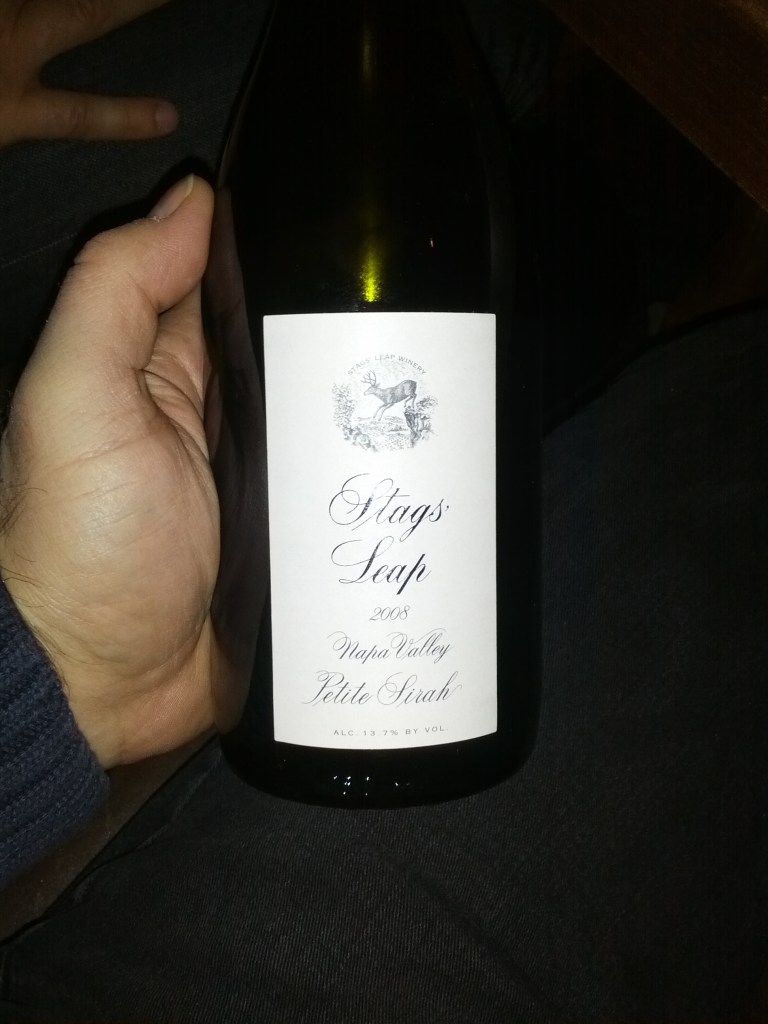
 Stag's Leap

We were pretty happy with our $13 bottle of wine, and here’s dad sending pics of a $37 bottle bought by some suck-up supplier. Not that we begrudge him…it’s freaking cold in Ontario and he deserves a little happiness. It’s just that we really needed him to be the tooth fairy and get that tooth.

PETER LEHMANN BAROSSA BRUNETTE (2008)—Don’t be a tool

My Fellow Inebriates,

Sixteen bucks in our local booze shop and we had ourselves a bottle of PETER LEHMANN BAROSSA BRUNETTE (2008). We’d had some luck with Peter Lehmann wines before, mostly because they’re competently made and easy to drink, and we held this one to the same expectations. How did it measure up?

peter lehmann barossa brunetteIn fairness to Peter Lehmann, his BAROSSA BRUNETTE was upstaged by an Argentine Malbec we enjoyed immediately before it (review to follow). Although we have friends who would debate this, the LBHQ policy is to have the lesser wine first, moving from good to better (we can’t afford “best”). It’s very pleasant to savor one wine only to have it topped by another. This way you get to enjoy both wines—the first in ignorance of the second. If you have the better wine first, whatever follows is going to seem like relative crap.
Well, yes and no. Sometimes it’s just a shock to the palate. Sometimes that second wine isn’t necessarily lesser—just different. You have to let those taste buds shift gears and adjust. If the second wine is decent, this usually occurs within one glass. However, if the wine is relative crap, you end up bitching about it until it’s gone, wishing it were like the first.

This may have been what happened with PETER LEHMANN BAROSSA BRUNETTE. Following a Malbec that overdelivered with complexity and ripe fruit, the Lehmann offering came across as one-notish, industrial swill. Which probably wasn’t a fair judgment. So let’s address it on its own merits.

To do this we have to dismiss our impressions of the first glass. All of us (bears, parents, our friend R) were getting pleasantly pissed when we opened the BAROSSA BRUNETTE. Almost pissed enough to enter the basement for Guitar Hero embarrassment.

We will ignore the first glass. A Guitar Hero interval…

Just what we needed to absorb the first wine. The second glass is fair game.

Okay, so LBHQ (and guest) impressions were as follows:

Dad:

Barnyardy…one-notish…mass-production…couldn’t get past the barnyard note

R:

Industrial/standard…thin…turpentine/petroleum…ish. Didn’t really quite work…

Mum:

Mass-market swill but not objectionable; I’m having more.

Me:

You guys really don’t have to finish it; I’ll take care of it.

The stuff is pretty standard and typical for its price range—certainly not a “find.” A 75:25 blend of Grenache and Shiraz and ringing in at 14.5% alcohol, BAROSSA BRUNETTE is earthy and dry with unexpectedly assertive tannins yet a surprisingly short finish. As much as we’ve been happy with previous Peter Lehmann buys, this one reeks of mass production and even has the sense of being constituted of leftovers. As R said, it doesn’t really quite work.

But there our criticism ended. We had alcohol to ingest and “Bulls on Parade” cued up. My dad kicked my mum’s ass; she is really never going to improve at Guitar Hero, but at least she has thumbs and can make the attempt. Between songs we dissed Peter Lehmann’s marketing team for the following ad copy about Peter Lehmann, the man himself:

Peter Lehmann logo

This wine is a testament to the man and his bravery to dream.

Even when you write your marketing copy in the third person, everyone who reads it knows you signed off on it. Or at least you should have, especially if you’re saying your product is representative of you and your bravery to dream.

I’d like to believe Peter Lehmann himself is blissfully unaware of the douchebag copywriting being done on his behalf. After all, the guy is 82 years old. If I were 82 I’d be hanging by the pool, and if I owned a vineyard I’d be wrecked all the time—too wrecked to care what anybody wrote about me.

Let’s hope that’s the case. But for any of you out there, let’s just say: Even if you write your ad copy in the third person, everyone who reads it suspects you signed off on it. So if you say you’re a “gifted innovator,” a “visionary,” or a “thought leader,” we generally read it as “dickhead.”

Note to anyone with a marketing bio: It wouldn’t hurt to self-deprecate a bit. Your work stands as its own testament, does it not? Don’t be a tool.

LUCKY COUNTRY SHIRAZ-GRENACHE (2009)—You deserve it, and so do my dad and Dan Ariely

My Fellow Inebriates,

By the end of his weekend bunkbed-building project, my dad was sweating. He totally deserved a beer. After all that effort, I thought he deserved something really extraordinary, but instead he chose a can of crappy (well, not crappy—at first I liked it, but then I had it again and I didn’t so much, expect that it’s good for getting gooned) beer. Seriously, if that’s what my dad gets for putting together a JYSK bunkbed set in under two hours, he has some self-esteem problems.

lucky country shiraz grenache 2009If it were up to me (and it never is) we’d at least shake the piggybank out for some LUCKY COUNTRY SHIRAZ GRENACHE (2009) from Australia’s famed Barossa Valley. Now, maybe the $17.99 price tag was a deterrent after my parents had shelled out $240 at JYSK. But how could it be? As financial ignoramuses (and they are), my parents should have been fully susceptible to the “anchoring” effect of just having spent a wad of cash. Spend $240 and suddenly $17.99 doesn’t seem like much. Ergo, there should be a bottle of LUCKY COUNTRY sitting at LBHQ right now, on its way to being empty.

It’s true—experiments have shown that consumers are highly suggestible when it comes to price points. Dan Ariely and Drazen Prelec did an experiment in 2006 in which they had MIT students bid auction-style on random items such as bottles of wine, computer accessories, and textbooks. But before they bid on a particular item, all students were asked to write down the last two digits of their social insurance numbers.  Then the auction took place and the students made their bids.

Dan Ariely obviously knows his stuff.

Dan Ariely obviously knows his stuff.

Weirdly, the students whose SINs ended in higher numbers (i.e., 97, 93, etc.), than students with lower-ending SINs (23, 16, etc.) ended up making higher bids for miscellaneous items. And not marginally higher—346 percent higher. Just writing those two SIN digits on a piece of paper had, the experimenters surmised, primed them to consider higher real-world numbers when it came time to spend actual money on an item at auction. Ariely and Prelec labeled these numbers anchors, and went on to point out that anchoring happens all the time, with all kinds of purchases. (These findings and plenty of other fascinating ones are detailed in Ariely’s book Predictably Irrational: The Hidden Forces That Shape Our Decisions.)

For instance, if you ate groundhog stew for dinner tonight, prepared from a roadkill specimen you found by happenstance for zero dollars…well. When you found yourself pricing ribeye steak at Safeway a couple of days later you might choke at paying $5.99/lb, deal of the week or not. Your groundhog was free, which tethered your mind to the idea that all meat could be free, and now Safeway’s offerings don’t seem so hot.

But if you recently spent $100 on an organic non-medicated turkey and wasted basted it with sparkling wine for Christmas dinner, now a $19 package of steaks doesn’t seem like such a burn.

Leaving me to reiterate: Where is our bottle of LUCKY COUNTRY???? Ripe and plump with Barossa Valley fruit and considerable tannins, this 2009 Shiraz-Grenache blend is promiscuous with blackberry, chocolate, and earthy notes. Its loose structure makes it a little sloppy going down, but so lush with black fruit that…who cares? It has depth if not definition, and the finish is lingering.

BarossaValleymapBarossa Valley is one of my favorite wine regions, and in our ‘hood $17.99 is a steal for a decent red from that part of Australia. If there are nicer wines from that area, they tend to cost $4-10+ more—the land of diminishing returns for buyers with budgets like my parents’. And let’s face it, we bought our bunkbed at JYSK, not Pottery Barn. Its price tag can only have ratcheted Dad’s spending anchor so much.

Another plus for LUCKY COUNTRY: You won’t find a critter on the label, marsupial or otherwise. Producer Michael Twelftree doesn’t go in for the mass marketing typical of Aussie wines. His wines are made the old-fashioned way, blended in small batches and minimally filtered. Which is to say, even if my dad had bagged a groundhog the other day, LUCKY COUNTRY wouldn’t have sprung to mind as an accompaniment.

Who needs food, anyway, people? Just get your mitts on some of this awesome and affordable Barossa Valley wine, and drink it as is.