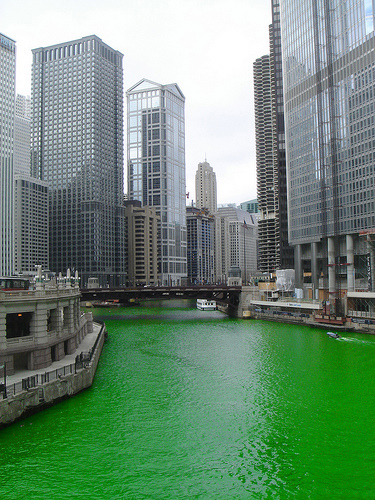
Excrementitiously green without dye—the Chicago River

OMG, look what they do to the Chicago River every year.

What’s the deal with dyeing the Chicago River green every year for St. Patrick’s Day? I thought the picture was photoshopped at first, but Chicagoans actually do this annually, my fellow inebriates. WTF?

I mean really—WTF? Where did this idea come from? From a historical perspective, throwing dye in the river is almost as arbitrary as throwing partially treated poo into it. At what point did this sound like a good idea?

The story is told with unapologetic glee by Dan O’Leary, who equates the Chicago River’s yearly “spectacular transformation” with the parting of the Red Sea. In 1961, plumbing engineer Steve Bailey, in an effort to locate a waste line being emptied into the Chicago River, poured green dye into the waste system and then checked to see where the color would appear. Overjoyed by the change from murky, excrementitious green to vivid Leprechaun green, Bailey suggested the city dye the entire river green every year to commemorate St. Patrick’s Day. Strangely, the city went for it, and Bailey helmed the operation, pouring 100 pounds of fluorescent compound in the first year, then playing with the amount over the next two years until he arrived at 25 pounds, enough to make a “carpet of green” for one day.

With dye

Bailey thought this was awesome; he was passionate about St. Patrick’s Day and wanted to dye all kinds of things green. You’d think Chicagoans would have questioned what chemical was entering the water, but it took until 1966 for environmentalists to point out that the oil-based dye was harming aquatic life. This cracked Bailey up and, despite not giving a shit about that sort of bleeding-heart concern, he concocted a new vegetable-based dye. This concession may well have killed him, as he died that year. Then again, maybe he just ate a lot of Ulster fry-ups.

Without dye

The Chicago River is one of the filthier rivers, with an estimated 70 percent wastewater. Over a billion gallons of sewage is poured into it every day, begging the question: Isn’t it green enough? And if Chicago thinks it needs to be greener, why not actually “green” the river?

Although money is predictably tight, private companies such as the Wisconsin brewer Leinenkugel have stepped up to raise both cash and awareness through Friends of the Chicago River.

I’d never heard of Leinenkugel beer. Our Canadian government-run liquor stores don’t carry it, so I don’t imagine I’ll get the chance to try it. Thinking about Leinenkugel’s concern for clean water gives me…well, delirium tremens, if I’m being honest. I’d love a beer right now.

So what is Leinenkugel beer like? I wish I knew! Apparently they have a damn fine amber ale. Anyone care to write a guest review?

The countdown’s on…get your green on

My Fellow Inebriates,

One of my fave pubs

If you’re in an Irish pub you’re very likely to see a countdown prominently displayed. Pub owners get excited this time of year. They’ve endured over two months of winter doldrums, and they’re gearing up for the quintessential party that will bring in bar patrons and trigger them to start spending again: St. Patrick’s Day.

Isn’t it fitting that in 2012, our final year if you’re consulting the Mayan calendar, St. Patrick’s Day should fall on a Saturday? Propitious for pub owners and patrons alike, St. Paddy’s Day is a fantastic opportunity to cut loose, embrace the coming spring, get drunk, get naked, and embarrass yourself.

OMG, look what they do to the Chicago River every year.

St. Patrick’s Day is a curiosity in that it seems to transcend religion and ethnicity. Everyone happily clambers on board and becomes Irish for a day without involving any religion-based controversy. Happy happy! Whatever we’ve done as a culture to arrive at a day where everyone gets together in friendship to get blitzed, we’ve done it right. Think about it…Christmas has become a tug-of-war between secular and religious domains who argue over the appropriateness of manger scenes and the origins of the holiday. Easter juxtaposes uneasily with Passover, intermingling images of a springtime bunny and slaughtered lamb’s blood. Even Halloween has detractors who insist its dark themes invoke Satan. And somehow—despite being named after a Catholic saint—St. Patrick’s Day manages to please both secular and religious camps. Why is that?

Perhaps it’s because the occasion is primarily a New World phenomenon. Whereas the date of St. Patrick’s death was commemorated in Ireland as a religious holiday on which Irish people would go to mass and then have a nice meal, Irish immigrants in North America took it to a whole new level, tying it to revelry and drunken merriment in a way that stuck and spread worldwide, eventually spreading back to the homeland and elevating a formerly minor holiday to the status it holds today.

Essentially the modern idea of St. Patrick’s Day incubated in North America independently of Ireland and in fact burgeoned into the commercial celebration it is during the height of the Troubles in Northern Ireland, gaining popularity among expatriate Protestants and Catholics alike and eventually becoming known as non-sectarian.

Surely this illustrates the power of alcohol to bring people together. If all holidays were focused on drunken revelry, so many of society’s problems would be solved. But did St. Patrick have any idea of his future legacy? Who was that dude, anyway?

St. Patrick was British. It’s true, he was a wealthy Brit whose family owned slaves. Everything changed when he was kidnapped and brought to Ireland as a slave to herd sheep. Wow! Talk about comeuppance.

He wasn’t particularly religious, although his childhood home was Christian. Finding himself among sheep, he started to hear voices and experienced a conversion.

He used the shamrock as a metaphor for the Christian Holy Trinity.

He banished Ireland’s snakes. Nah, he really didn’t. Ireland doesn’t have any snakes, and it never did. It’s too cold and bounded by water. Snakes have no reason to go there and no means either. They are most likely a metaphor for Druids, who steadily disappeared after St. Patrick embarked on his mission to convert Ireland to Christianity.

He lived a long time ago. St. Patrick died in 461, since which time traditions such as wearing green and drinking 13 million pints of Guinness every March 17 have sprung up. Curiously, prior to North America’s remaking of St. Patrick’s Day, wearing green had always been considered unlucky inIreland. Traditionally the faerie folk dressed in green and would kidnap children who wore their favorite color.

St. Patrick’s lasting gift to Ireland has been tourism. Millions of travelers would never have thought to visit that rugged and beautiful country if not for his story.

Something like a quarter of North America claims Irish descent, a figure that probably defies math. Irishness seems to appeal to people, and even those with an eighth of it in their blood will say on March 17 “Kiss me, I’m Irish.”

As you may recall, Fluffy, the possessed bear living with us now, is Irish. This dampens my enthusiasm for St. Patrick’s Day considerably. I wonder whether he will gather up his strength for that day and then unleash demonic wrath on us. He’s been building up to it gradually. Last night he turned the bathroom fan on (with his mind, people!) and made the computer go blue-screen while I was on Facebook (again, with his mind!). Is there nothing he won’t do?!