WISER’S SPECIAL BLEND—Making Johnnie Walker its bitch

My Fellow Inebriates,

As exhilaratingly nasty as our last whisky tasting was, LBHQ isn’t big enough for a substance as raunchy as JOHNNIE WALKER RED LABEL. Our tastebuds aren’t sure whether to bother growing back until the bottle’s finished, but kudos to my dad for bringing home such a coarse, discordant palate-abuser.

The hell, you say. There’s no reason to laud such a purchase, is there?

Well, first of all, buying JOHNNIE WALKER RED isn’t the worst choice my dad’s ever made. Just last weekend, for example, he locked his car keys in the trunk of the car. Ka-ching, $60, and roadside assistance popped the mechanism (I had a vision of FOUR mickeys of crappy whisky floating away, all for naught).
Second, products like JOHNNIE WALKER RED serve admirably as tastebud resetters. By burning all your tastebuds off, they destroy the memory of what a good whisky tastes like, zeroing out your expectations (and in fact, my second glass of JOHNNIE WALKER RED was considerably more tolerable than the first). Effectively you get re-accustomed to cheap crap, which is good for your budget.

Third—and I could be totally wrong about this, so perhaps some neo-Darwinians out there will correct me—only the toughest tastebuds survive the bad-whisky assault, and after repeated assaults these hardy little meat-pixels dominate your tongue’s surface, where they not only welcome solvent-like booze but ask for more. Not only is this good for your budget; it also tricks you into thinking you’re enjoying your cheap crap.

Win-win-win.

The only downside about JOHNNIE WALKER RED is that it’s not as cheap as it could be. About $16 buys you 375 mL, but for $11.87 you could have WISER’S SPECIAL BLEND.

But wait, you say, I only just survived JOHNNIE WALKER RED. Surely WISER’S SPECIAL BLEND, at three-quarters its price, will be paint thinner itself.
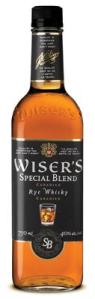
Surprisingly not. Deep amber-gold, WISER’S SPECIAL BLEND opens up gently with a light grain aroma that develops quickly—wood, vanilla, and a hint of caramel. It spreads over the tongue with a warming, smooth oaky-caramel release, lingering with polite heat and a slight medicinal hint.

For a cheap whisky, WISER’S SPECIAL BLEND has a lot going on. Whereas many of its fellow Canadian whiskies fall short on character, WISER’S offers plenty of depth and layering, and enough balance to hit a wide range of whisky-drinking tastes. With its unexpected subtlety, and for the most reasonable dough possible, it makes JOHNNIE WALKER RED LABEL its bitch.

For sure, there are more complex whiskies out there, but you won’t find them in big-ass 1.75-L bottles with a mere $56 price tag. Which is about the cost of unlocking your trunk to retrieve your car keys. 😦

JOHNNIE WALKER RED LABEL—Get rough with yourself

The latest household excuse to drink is that it keeps us out of the snacks at night. Now that my parents are well into their forties, they have to think about spare tires and heart health. No longer can they hoover back a tub of Breyer’s—at least not without foraging for aspirin to take care of that pain shooting down their respective left arms. Far better to have a dram and call it a night.

What exactly is a dram? I thought I knew what a dram was—surely it’s a generous shot, or at least a shot, right?

OMG, it’s not!! A dram, defined in apothecary terms, is one sixteenth of an ounce, my fellow inebriates, 1.77 grams—a mere taste, my fellow inebriates, and absolutely inadequate for taking care of the DTs.

What we need is a wee dram. A wondrously fluid measurement, a wee dram refers to a taste of your favorite whisky, poured at your discretion. Ahhh! So a wee dram can refer to that very generous shot you pour yourself, or to that very parsimonious finger you might reluctantly pour for some douchebag. A wee dram can be a tipple, or it can get you totally wasted.

The one constant about the wee dram is that the whisky must be something nice.

So when we had a wee dram of JOHNNIE WALKER RED LABEL last night, we really didn’t. Because RED LABEL is decidedly not nice. And it wasn’t an actual dram, because when I pour a finger it’s more like a paw.

How did I get my paws on this wretched JOHNNIE WALKER RED? My dad had just put up a bunch of shelves in the garage and sorted out a whole bunch of documents to take to his accountant. He deserved some booze. And he thought I should actually review something instead of trawling for half-assed memes and dishing unsolicited advice about constipation and flatulence.

I had moderate hopes for JOHNNIE WALKER RED. It has a really bad bottom-shelf reputation despite not being the cheapest of the cheap. If only because JOHNNIE WALKER BLACK is so respectable, I thought RED LABEL would at least faintly echo that quality. Then again, there’s a reason brands like Johnnie Walker and Smirnoff diversify across price points—they don’t just court silky, moneyed palates; they want hobos, too, and bears who enjoy the company of both.

With its entrancing honey color, you can’t fault JOHNNIE WALKER RED LABEL until you’ve opened the bottle. Then you get a whiff of sweet malt, peat, alcohol, and floor cleaner. The body is solvent-like. I remember one time I thought we were never going to buy alcohol again and I started eyeing the Windex; I swirled the bottle around just to see if it had good legs and wondered whether it would really make me go blind. JOHNNIE WALKER RED LABEL is ever-so-slightly thinner, albeit more appealing.

On to the taste.

The palate can’t very well say it hasn’t been warned. This is going to be some rough shit. And it totally is, my fellow inebriates. Sharp, bitter alcohol and raunchy peat beset the palate, seconded by dirt and sourness. The burn is short and fiery, like being kicked in the kidneys or getting your fur waxed by a beauty-school trainee. This stuff is fuel, people. I totally loved it.

JOHNNIE WALKER RED LABEL demands ice to be drinkable. Enough ice to ensure that, no matter how slowly you sip (for the masochists out there), there will always be ice so you can tolerate it. You do not want the ice to melt. You do not want to properly taste RED LABEL.

And for the body-conscious, some good news: this shit will trash your palate. There’s no food you could possibly enjoy afterwards. Go to bed and let your tastebuds grow back, then have some more JOHNNIE WALKER RED LABEL in the morning. That’s what it’s made for.

SANTA ANA CASA DE CAMPO TORRONTES (2010)

Tonight is Meet-the-Teacher evening and my parents’ latest killjoy rationale for staying sober in the early afternoon. (Others include “working” and “taking the kids to the park.”)

And then there’s the overriding concession to social mores: “It’s early, buddy.”

Which got me thinking: How early is too early? Do you have to be middle-aged, uptight, and live in Langley to eschew alcohol before 5 p.m.? Or does everybody operate that way except yours truly and his hobo cohort?

Because, seriously, if the clock says 4:59, my mother won’t crack a beer. If it’s not 5:00, it’s not happening—unless it’s Christmas or her birthday or Thanksgiving or Canada Day or we have company or somebody else does it first. Since the most obvious somebody doesn’t have thumbs to open bottles, and most days aren’t celebratory (I pitched Rosh Hashanah but she didn’t bite), the clock tyrannizes me with its slow ticking toward happy hour.

Apparently all societies have proscriptions on time of day for drinking. (Holy crap, why?) Jittering away until dinner is a cross-cultural norm, my fellow inebriates. A study of 14 countries shows that drinking is much more prevalent after 5 p.m. and on weekends. Drinking that occurs outside of these socially determined times correlates strongly with alcohol-related social problems. Researchers concluded that problem drinkers were most likely to drink at these times. OMG!

The study strikes a note because I would be more likely to drink at these times. If I had my druthers, by 5 o’clock I wouldn’t be drinking anything at all; I’d be heaving away somewhere behind the couch.

But I’d never have sampled SANTA ANA CASA DE CAMPO TORRONTES (2010). It would have been drunk by my parents (“peacefully”) during my passed-out time.

Torrontes grapes look a lot like the green grapes you find at the supermarket. I have no idea whether they’re the same, nor has it occurred to me to eat them, but if they are, the kids’ lunchbags often contain the ingredients for a fresh, aromatic white wine with moderate acidity. Not a waste, as the kids do need to eat, but it’s good to know Torrontes grapes abound throughout Europe and the Americas. Three variants exist, the most common being Torrontes Riojano, the most likely ingredient in SANTA ANA CASA DE CAMPO.

Torrontes doesn’t age well and is best consumed within a year of its vintage. If you have a bottle from 2010 you should drink it right now, even if it’s not 5 o’clock yet.

I expected a mellow, caressing Torrontes-style fruitiness to wash over me, so the zestiness of SANTA ANA CASA DE CAMPO was bracing. Pale lemon yellow, it exudes fragrant citrus and floral notes, perhaps some jasmine tea. One whiff and you know this wine isn’t mellow; it’s zippy, zingy, and whatever other Z words you can think of. The aromas translate logically from nose to palate—bright, well-balanced chords delivered with light-to-moderate mouthfeel and a finish that doesn’t overstay its welcome. Certainly a yummy wine, but not as generous and lingering as the varietal can be.

The bottle recommends pairing SANTA ANA CASA DE CAMPO with seafood or spicy cuisine—i.e., dinner. But this seems too late in the day to enjoy such a crisp Torrontes. Better to pair it with a spicy breakfast omelet.

Better still, just wake up and open the bottle.

(Holy crap, where is the family? I thought it was Meet-the-Teacher evening. It’s night! There are stars out! Do you think they’ve made a detour to the liquor store?)