BESO DE VINO (2009)—Worth drinking but not saving

Get this, my fellow inebriates: My parents are so disorganized that they actually had to call the movers and ask them to come a day later. Luckily they picked an odd time of month to move, or we’d have been S.O.L.

Why could they not get their shit together in time? What is wrong with them?

In addition to being video-game addicts and procrastinators, over the last six years I’ve come to suspect they possess a gene or gene combination responsible for hoarding behaviour. Tell me, who has 14 non-working stereos? Who hangs on to books that are embarrassing (The Yeast Syndrome, How to Write Erotica)? Who has just been forced to work backwards through four years of unopened mail?

There is indeed a genetic marker associated with hoarding, located on chromosome 14. Hoarding is a subtype of OCD that tends to run in families. But my parents can’t blame any familial line for their propensities, although you don’t have to delve too far into the family tree to find moderate insanity (and—as summer’s open windows bear our conversations aloft—our neighbours probably suspect my mother of another chromosome-14 disorder, Tourette’s).

In all likelihood my parents are just disorganized, which might explain why, without managing to pack all the stuff we’re not using, they’ve packed our few meager alcoholic items along with all the wine glasses. They won’t find that stuff for days, even weeks, which leaves us without glassware to christen the new LBHQ. Hell, it leaves us without glassware when we feel overwhelmed and desperate later today. And it means no one will be buying new wine until we find the glasses—OMG!

In fact, we’re all caught up on wine reviews, except for one bottle.
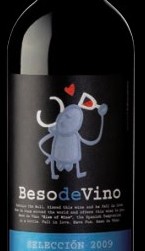
Wine Advocate gave BESO DE VINO (2009) 90 points, a too-good-to-be-true score for a $13 wine. Not that we haven’t had awesome $13 wines, and for all we know, reviewer Jay Miller was taking into consideration the low price. But this ain’t no 90-point wine.

Antonio the Bull, amorous animal with low-swinging balls, is the frontman for this Spanish Syrah/Garnacha blend. Usually my mum knows better than to purchase wines whose labels feature livestock, but  the pricetag talked her into it—especially since it had a blue-and-black label rather than a yellow-and-red one (avoid!). BESO DE VINO seemed safe, and we’ve been having good luck with Spanish wines lately, so she plunked down the $13.

It’s hard not to like this goofy little bull and his mondo testicles, but you can’t rely on his tasting notes. Sure, the wine is a lush and opaque purple, but it doesn’t serve up the promised aromas of “roasted coffee, baked berry, chocolate covered espresso bean…” It serves up a grape-juice fragrance—pleasant, fruity, and full, but juvenile somehow, even though I couldn’t detect any nuts. Now, maybe we were primed for an impression of immaturity by the bull’s jouncing teabags, but honestly, there isn’t much on the nose.
Does Antonio realize bulls don’t often live past 15 years old?

On the palate BESO DE VINO comes through with full-bodied dark fruit and a generous mouthfeel along with some modest tannins, but it still suggests a kid’s juice box rather than the Reidel glasses we’ve prematurely stowed. Although I could pick out some of the suggested coffee notes, some earthiness, and some spice, BESO DE VINO isn’t much more than a half-decent table wine. It would taste just fine, for instance, with some cheese strings or Lunchables.

Still, you can’t argue with $13, and there’s nothing offensive about BESO DE VINO, except maybe Antonio the Bull’s dangling yarbles. It’s worth drinking once, but not worth hoarding a supply (really, parents).


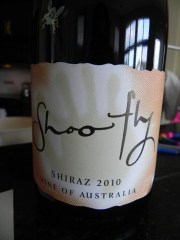
SHOOFLY SHIRAZ (2010)—Call that koala off!

My Fellow Inebriates,

Today the whole family’s out looking at our new headquarters, so naturally I’m wondering what I can get up to.

But without thumbs it’s hard to get up to much.

My fur hurts.

And then there’s this raging, fur-blasting headache. Did my parents offer me a painkiller for it before they left? Noooo. They helped themselves to 400mg ibuprofen each, then stowed the bearproof container on an upper shelf.

So why do we all (minus the kiddies) have this thwacking great headache? Reluctant as I am to blame SHOOFLY SHIRAZ (2010), the evidence is pretty solid. Two glasses of red wine shouldn’t do such a number on the old brain pan.

Red wine, along with Scotch, bourbon and anything dark, is famous for causing headaches. But the evidence tends to be anecdotal and fraught with variables. How many drinks? At what level of hydration? With or without carbonation? Consumed exclusively or mixed with different alcohol types?

It’s red wine that gets the worst rap. Why do some wines inflict more next-day head pain that others?

Nobody really knows.

According to Winegeeks, from which I swiped much of my information, the cause of red-wine headaches hasn’t been precisely determined. But here are some suspects:

  • Sulfites—natural byproducts of yeast added to ensure clean fermentation. But white wine typically contains more sulfites than red.
  • Histamines—plant and animal substances that spur allergic reactions. While they are more common in red wine than white, the data are inconclusive. For one thing, histamine occurrences are very low. For another, a study from the Journal of Allergy and Clinical Immunology showed no difference between the side effects suffered by drinkers of low- and high-histamine wines.
  • Tannins—substances that give plants a bitter taste and produce that saliva-drying sensation you get from dry wine, tea, coffee, and nuts. They have healthful antioxidants but (one theory goes) may bind to starches, preventing their uptake and use in the brain’s manufacture of serotonin. Serotonin deficiency, in turn, causes vasoconstriction, which leads to migraines.
  • Congeners—chemicals produced during fermentation that contribute to the flavor of non-distilled drinks. These include acetone, acetaldehyde, esters, glycols (the list goes on), none of which sound too brain-friendly, although one congener in particular, fusel oil, contributes to red wine’s complexity. Dark drinks are generally more congener-rich than clear drinks. In a bourbon-vs-vodka study, subjects who drank bourbon suffered disturbed sleep and diminished performance compared to subjects who consumed vodka.

It’s all you. Or is it?

Individual susceptibility is also a factor. We all know people who avoid red wine because of headaches; likewise, plenty of people/bears enjoy a glass or three without ill effect. Our little tasting crew falls into this latter category, so when we find ourselves reeling around gripping our heads the morning after splitting one 750mL bottle of SHOOFLY between us, something’s up with that wine.

What about that SHOOFLY?

The 2010 vintage may be a little young. Even after we let it breathe a good 45 minutes, it exuded fresh yeast along with a rush of ripe berries and black fruit. Vinified from super-ripe grapes harvested from old vines around Adelaide, SHOOFLY is fruit-lush yet parchingly tannic—not massive but large and reasonably well structured. The finish is perhaps a little clipped.

Like many an Aussie Shiraz it packs a 14.5% wallop. It’s less a symphony than a kick-ass rock concert. Damn, I liked it last night. It even made my parents’ conversation about moving and finance a bit less boring.

Still, SHOOFLY isn’t tame. Maybe a year in the bottle would help it—but will the headache genie still come out with it? It’s a wild animal all right. I woke up with it clawing my melon from the inside like some scrofulous koala yammering sweet nothings at my two brain cells. I barely got through today.

What’s important, though, is that SHOOFLY is yummy booze for $18. And if someone will just open the Advil bottle for me, I’ll forgive it anything. Hell, if we had a second bottle I’d drink it right now. But I’d need help opening it.

SIBARIS RESERVA ESPECIAL CARMENERE (2010)

My Fellow Inebriates,

When the water hose came out today, we bears hid. I don’t know where the other animals went, but I’m currently hanging out beside an empty wine bottle of SIBARIS RESERVA ESPECIAL CARMENERE (2010). Named for the ancient Sybarites who sought pleasure to the highest heights, this wine was my parents’ contribution to our weekend tastings. Sandwiched that evening between a glorious cask-aged beer and a brown ale that hit all the right notes, SIBARIS had a tough go. One of its only advantages was that, being wine rather than beer, it would not have to endure apples-to-apples comparison.

Another assist came from a palate-bashing meal my mother inflicted on everyone just as we switched from grain to grape. This effectively reset everyone’s tastebuds, giving SIBARIS a chance to shine. How did it fare?

We were all in the mood for a big, mouth-filling wine. Carmenere, the signature grape of Chile, is often used as a blending grape because, while it’s full and lush, it lacks the tannic profile of Cabernet and has low acidity. But with careful vinification this varietal can rock a wine bottle all by itself, and that’s what we’ve been seeing increasingly at our neighborhood booze shop.

Perhaps my dad had an inkling that SIBARIS would only just live up to its $16 price tag. “We’re gonna let this one breathe in the glass,” he said, dumping it into Reidel stemless ware. Immediately the wine released juicy black plum and spice aromas. Despite not having decanted it, my dad let it sit awhile before tasting, but you know how alcoholics are—I dived in at once. Medium-bodied and plump on the palate, SIBARIS delivered flavor to the palate exactly as promised to the nose: intense yet accessible, easy to drink and yet not perfectly behaved. “Spunky,” said my mother, and Christine confirmed it was a “little barnyardy.”

Now, the barnyard is not always a negative, and this case SIBARIS walks a fine tightrope, albeit not entirely smoothly. SIBARIS is more than earthy; somewhere in its fruity, berry background is a persistent hint of gaminess. But just a hint. A terribly slight hint. In fact, if no one ever mentioned spunk or barnyardiness or caca, SIBARIS might have come and went without a hiccup. But once the suggestion was out, it was out, and we all detected a faint whiff of copros in the distance.

Still, for fifteen bucks this is a very decent wine. No one’s glass was left half-finished—despite the beckoning of a Shiraz Christine brought over in her canvas bag, which, an hour later, would completely trounce SIBARIS. But there are a lot of very nice $16 wines out there, so this one probably won’t be a repeat purchase at LBHQ.

Five days after drinking it, the empty bottle smells pretty darn good. Let’s just hope the empty patch is a good hiding place from the kids.