My Fellow Inebriates,
My boozy world has a very tight bandwidth of focus, so it was news to me that people have been occupying the Art Gallery lawn in my city. At first I thought it sounded like a great party—I thought about a keg, of course, and wondered whether my dad would drive me there with one.
 I guess the question is: Is my dad part of the 1% or the 99%?
My parents are your typical college-educated suburb dwellers, beleaguered as much by the minutiae of running small businesses as they are by parenting two crazy little kids. They wake up early and scurry around, brushing out tangles and finding socks, then get down to a daily toil that sometimes pays off and sometimes doesn’t. In the evening they might have a beer, or they might not.
Mathematically, they are 99-percenters. Which makes me one too.
But there’s a growing sense of distaste being expressed among many people who unquestionably fit by economic circumstance into the 99% but refuse to identify either with it or with the Occupy movements taking place across the world. They consider themselves hard-working and well-meaning—middle-class—and therefore too many steps away from flat-out poverty to actively contemplate being a have-not. They see themselves as functioning within society, and have a concomitant horror at the self-avowed 99-percenters who raise alarm bells at the widening gap between rich and poor.
 The reason is simple: Poverty is ugly.
When I’ve had ten beers and thrown up all over my fur, and I’m lurching around, groping whatever genitalia get within range, I’m ugly too. My drunkenness is ugly, and moreover, it illustrates the path from moderate drinking to dependency. It raises questions like, “How did that bear get so f#cked up?” and “Could I end up that f#cked up too?”
Sound familiar?
Alcoholism is ugly. And any moderate drinker is a number of scarily ill-defined steps away from it. What puts you over the line? Drinking to the point of black-out? How many times? How often? Drinking by yourself? Drinking in the morning? Is there a line you can cross…?
It’s sort of like poverty. You may be doing fine right now. You have a mortgage and one or two cars, a couple of credit cards and a job. You’re making ends meet and you’re doing fine; you’re fitting in with the societal framework and managing. Surely you’re not a 99-percenter, whinging about social inequity.
But give these variables a shake. Say your job goes pear-shaped; say you have an accident; say you have an extra baby by mistake. Now it’s a little more difficult to work the system. Now say the interest rate on your mortgage goes up and your kids’ new teeth are growing out sideways. Oh yeah, and your car blows its transmission a month after warranty expiration.
 Anybody’s life can turn into a country music song, people.
We’re all taking a big leap of faith in believing that the system works well and that we are coping optimally. Do you say stuff like: “Things are great now but I’m really glad I’m not a senior”? Or “I’m so glad I’m not just out of high school and trying to pay for an education”? Or “I don’t know what I’d do if I didn’t have a job with dental coverage”?
For any person, there are x number of “ifs” that probably won’t happen, but could happen, to pull the rug out. And when the rug gets pulled out, we look for the safety net. For most people, that safety net is credit. It feels like a safety net because it keeps the wolf from the door, but the more you use it, the deeper you find yourself in a usurious quicksand.
Okay, you say, but that’s my own fault. Just like it’s your fault for getting blotto and sleeping in your own sick. Ouch!
Let’s leave my hobbies aside for a minute. I’m just a bear.
 Some debt is considered responsible (mortgage) and some is not (depreciable items). Cars fall into the latter category, but how many non-bears function without a car? Most people of limited means have moved farther and farther from their respective economic centers, necessitating travel to and from work. Inadequate transit makes a car the only realistic option, especially if a family also needs rides to and from school and extracurricular activities within suburban catchments that tend to be too far-flung to manage on foot. People in the ’burbs pay more for gas and sustain more vehicular wear-and-tear. They pay tolls, which will soon be inescapable regardless of route taken.
Food? Anti-Occupy propagandists slam debt-strapped families for living the “high life,” eating out several times a week and not appreciating the wonders that corporations have bestowed upon civilization. But families eat out because both parents work and neither Mum nor Dad has time to put together a proper meal, do homework and get the kids washed for bed. Add to that the guilt they feel at being absent and being tired, and it translates into spending. If some of this spending is self-medicating, surely it attests to the stresses inherent in our social structure.
 Let’s talk about Stockholm Syndrome. People who suffer from Stockholm Syndrome paradoxically empathize with their captors. Isn’t this sort of like thanking credit card companies for allowing you to pay them 20% interest on purchases such as groceries and dental work, all the while inwardly blaming yourself for failing to predict your tooth will go critical?
My mum says she sees people putting groceries on credit cards all the time. What does this say about our finances? Shouldn’t credit cards be reserved for emergencies, or at least for online purchases of Liquorstore Bear swag? Seriously, back in the day, people would have been embarrassed to put milk, eggs and bread on Visa.
Wait a sec…embarrassed… Again, the fault is placed on the consumer. Surely no one wants to use credit to buy necessities.
The average Canadian owes more than a year’s worth of income.
Canada’s banks earned $4.56 billion in the third quarter this year.
If you think that really sounds fair, consider whether that judgment is a way of distancing yourself from people you find distasteful. And then think about where that impression came from.
 I’m a distasteful character myself. So I liked my first impression that the Art Gallery camp was so much drug- and alcohol-fueled fun. But my parents made me sober up and read a bit—just a bit. And this quote struck me:
“Without actually conversing with the regulars at the art gallery grounds, it’s easy for cynics to frame the scene as a disorganized collection of druggies and thugs, when actually some of our city’s best and brightest are still active there. Examining it as a whole, in all its contradictory parts, Occupy Vancouver is the elephant in the living room-both a reminder and a response to a broken system. We can shoo it off or shoot it dead, but the social problems feeding this unpredictable pachyderm aren’t going away soon.” —Geoff Olson, The Vancouver Courier
Some political science guy from UVIC said today on the radio that the Occupy movement had accomplished about half of what it had set out to do. Unfortunately, focus has shifted from the movement’s aims to the mayor’s aims to eradicate it. If, instead of visiting the Occupy Vancouver website I’d relied on radio news and my local rag for information, I’d have thought the Occupy movement was a big party for the homeless, with the intent to f#ck shit up and dis the Man. Instead I found it to be a peaceful and thought-provoking gathering of largely educated people who want to fix a broken machine.
 And yes, they do realize that as a civilization we’ve had it pretty lucky. They readily acknowledge how nice it is to have hot running water and central heating and computers and hybrid cars and all the rest of it. And, unlike corporations engaged in fracking for the last vestiges of oil the planet will cede and meanwhile poisoning the water table, they do foresee a sobering end to the bubble. Doesn’t it make sense to curb corporations’ sociopathic unaccountability before everything blows up?
So I guess my dad was right to scold me for thinking the whole thing was a kegger. But, still, I realize the Occupy movement is not the venue for Liquorstore Bear. I would be a bad element and detract from its credibility. And the media is already having a heyday doing that. So I’ll occupy my liquor cabinet physically, but Occupy Vancouver in spirit.

 ROLF BINDER HALES Barossa Valley Shiraz is a spectacular example of that ripe, intensely layered fruit that comforts me so much. Floral on the nose, it rewards the drinker with symphonically placed cedar and blueberry notes, good body, and an endless finish.
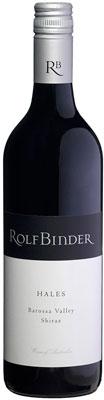 ROLF BINDER HALES is 90% Shiraz, collected from several vineyards along the western coast of the Valley, and 5% contributions from Grenache and Mataro grapes.




 Liquorstore Bear