
I don’t know how I missed this Kids in the Hall skit when it originally aired. I must have been drunk.
alcoholism
WHYTE & MACKAY SPECIAL—If you have to pay sin tax, pay it on something cheap
My parents are refusing to buy any more booze. It’s too expensive and—if you believe the dire predictions about the upcoming privatization of BC Liquor Stores—it’s going to get more expensive. I don’t know what’s cooking in my parents’ heads right now…they’re planning a change of headquarters…they’re doing budgets—all painfully boring and seemingly designed to torture yours truly.

Why is alcohol so expensive in Canada?
Seriously! A 750mL bottle of JOHNNIE WALKER BLACK LABEL is $49.99 in Canada versus $34.95 in the US. With our dollar just a couple of cents off par, what could explain this massive difference?
The answer is excise tax, imposed in Canada on goods such as tobacco, alcohol, gasoline, and vehicle air conditioners. Also known as sin tax, excise tax operates in theory as a disincentive to use harmful products, even though these products are often labeled inelastic precisely because imposition of tax (or any other variable) has little effect on net consumption.
Huh?

Essentially, the argument goes, people smoke, drink, drive, and cool themselves as per their own ideologies and lifestyle choices. Increasing or decreasing tax on these choices does not markedly change them; studies show that people continue to consume what they consume—they just bitch more about the prices.
But does this mean excise tax serves only as a penalty for “sin”?
Not according to the prevailing wisdom on excise tax—that higher prices deter consumption while (circuitously) offsetting associated health costs.
 It’s hard to pin down the correct assumption. Would hardcore smokers smoke four packs a day instead of two if the price were cut? What margin of society would stay constantly drunk if booze were cheap? Given people’s jobs and obligations—not to mention public proscriptions against public smoking and drinking and social pressures to at least approximate a healthy lifestyle—it’s hard to imagine that, at least for the majority of people, tax cuts would launch them toward debauchery. Not everyone is as thoroughly lacking in judgment as your host here.
Arguments in favor generally fall into three categories:
- Moral. Excise tax gives pause to people who would otherwise show no restraint. But can you derive good, “moral” behavior through monetary means? Is the tax a disincentive or a punishment?
- Medical. Forty-five thousand Canadians die from smoking each year. Alcohol-related costs are harder to isolate, however. A glass of merlot with dinner is heart-healthy; a box of merlot is not. The healthy “sweet spot” lies somewhere on the continuum between. How can it be defined without Big Brother’s assistance? Surely, if one glass is healthy, that glass should be subsidized, not taxed…
- Financial. Especially in countries with tax-funded healthcare, smokers and drinkers burden society with their treatment costs and should therefore pay taxes on the products that eventuate in their ailments. Or should they? According to a Dutch study, overall lifetime health expenditure is highest among healthy-living individuals, precisely because they live longer, whereas their smoking and/or obese counterparts check out earlier, relieving the medical system. Wow!

Photo: CBC
But conclusions from a study conducted in the Netherlands don’t necessarily make the leap to Canada. More relaxed attitudes toward alcohol, reduced emphasis on driving, and a greater acceptance of socialized medicine contrast glaringly with Canada’s moralistic attitudes on alcohol. Whereas alcohol is a casual element of European dining that extends to teenagers, in Canada and the US, alcohol gets built up to Holy Grail status, leading teenagers to binge-drink at the first opportunity. All-or-nothing morality guides prohibitions on youthful drinking (dry grad, anyone?), leading to adolescent obsessions with alcohol (“I’m gonna get so wasted”) as opposed to healthful incorporation of alcohol as a life skill. So when doctors write in the Canadian Medical Journal that alcohol costs Canadians $3.3 billion in annual health costs, they’re not joking. But is the solution to tax the shit out of alcohol, or is it to educate people on how to use alcohol safely?
 Admittedly it’s too late for me, my fellow inebriates. For now I take refuge in cheap finds such as WHYTE & MACKAY SPECIAL BLENDED SCOTCH WHISKY. At $25 for a 750mL bottle you really can’t do better—at least not in Canada. THE DALMORE SINGLE HIGHLAND MALT is the primary backbone, blended with some well-judged mystery whiskies, and treated with double cask maturation. Generous and malty on the nose, WHYTE & MACKAY is a lovely amber and offers rich malt and sherry on the palate, tapering from sweet to dry and lingering pleasantly. There’s no smoke to speak of and little complexity—but there’s nothing offensive either. This is an excellent rocks Scotch—an easy, undemanding sipper for when you want a wee dram without feeling too extravagant.
RIP, Whitney, if you were riding a kangaroo I’d find you more interesting
My Fellow Inebriates,
I’m a young bear, so I missed the whole Whitney Houston thing, but so did my parents. By the time she was making hits, they were old enough to have dismissed Top 40 pop in favor of the 1980s underbelly counterculture. By the time she was snorting her riches, they’d settled into middle age and were being exposed to her songs, sometimes for the first time, by watching teenage wannabes covering them on American Idol.

Whitney Houston with George Bush in 1990 (surely he could spot the signs)
Public speculation about Houston’s death is cycling through cocaine overdose, pills, drowning, and suicide as the media feast on her death and the unhappiness that must have preceded it. There’s something about an addict that makes him/her fair game—perhaps a perceived choice to follow the highway all the way to hell despite the obvious turnoffs and advisories. Particularly when the addicted are also the rich and spoilt.
It was on this note (wishing I were spoilt) that I appealed to my parents for a little taste of the Bowmore 12 that our friend Robert left behind (unknown to me) after his visit last weekend. Although I sampled it then, I had no idea any remained, both because I passed out ahead of everyone and because I’d assumed Robert would have taken the bottle with him when he left.
 But when I was skulking around the cupboards this afternoon I espied the bottle. Water in the desert! I had to hang on to the walls; my fur was standing on end. The only mildly cautionary twinge holding me back was the song rattling away between my furry ears: “and Iiiiiiiii—Iii—Iiiii–Iii will always looo—ooooo—ve yoooo—ouuuuuu…” It seemed a little tasteless to go hunting for a fix after reading about Whitney Houston being found dead in her bathtub. Although songs like these typically send me running for aspirin and/or alcohol because they pierce my sensitive bear eardrums, I felt bad that she was dead and sad that everything had gone to hell for her.
Nevertheless, I mentioned to my mum that I wouldn’t mind some Bowmore 12 right away, which she ignored because she was putting Shake ‘n’ Bake on some chicken. We are all addicted to something, and that gloopy, cornstarch-laden teriyaki flavoring, she knew, would entice the kids to ingest some protein simply because it contained so much sugar.
 In that sense, addiction is a bit of a continuum. Plenty of people have difficulty functioning without their morning coffee, or a chocolate bar during the afternoon slump, or a glass of wine in the evening to help them sleep. My mum has probably never gone a day without chocolate, and my dad devours tubes of Pringles at a time in the car. Are they addicts?
Not really—I mean, unless my dad’s hoovering Pringle crumbs off the car floor in desperation to suck up every last atom of their mashed-potatoey junkiness, or unless my mum’s packing a gun to protect her stash of KitKats. Don’t get me wrong, my parents have their assholish moments, but their dependencies are “lite” compared to the raging coke addiction that reportedly held Whitney Houston in its grip.
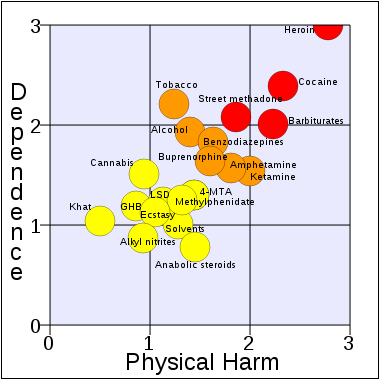
 Cocaine is an asshole drug like no other. We’ve all met asshole alcoholics—lurching around their homes with tumblers full of wine, operating under the permanent delusion that no one sees their weakness; cloaking themselves in legal sanction as proof that they’re just fine the way they are; even endangering others with their cars. Alcohol has a tragic side, there is no doubt, and even though we joke about it at LBHQ, we don’t endorse carrying it to asshole proportions.
Source: The Lancet
A drug like alcohol, if abused, can destroy an individual or a family over a span of years. A drug like cocaine (which arguably can’t be simply “used” as opposed to “abused”) can destroy lives in a relative blink. My parents had a coworker who discovered crack cocaine and within six weeks spent his family’s life savings; he asphyxiated himself in his garage, leaving a wife and two young children. Another acquaintance of my mother’s, casually introduced to cocaine, ended up dead six months later on the street where she’d started hooking after leaving her husband and children.
It trips me out that these were real people and not movie characters. Their lives went out of control before anybody even knew what had happened, what they were into, and how lost they were.
So it’s hard to work up too much sadness about Whitney Houston. She had glamour, she had talent, she had money, she had minions to do her bidding and get her whatever she wanted—even if what she wanted was coke.
If you think my jones for Bowmore 12 is hypocritical, you’re absolutely right. But I’m a bear, and I don’t know any better. All I can do is say—helplessly and perhaps unconvincingly—that alcohol, at least for the majority of the population, is something we can handle responsibly and controllably. We can at least contain it, confine it to our homes and keep it off the roads, and adhere to sensible laws that minimize its ill effects.
Cocaine cannot be used sensibly, controllably, responsibly, or safely. Its defining characteristic is the change it brings about in personality: the way it ratchets up the ego, then plunges the user into desolation. Cocaine users will snort spilled product off a dirty hotel-room rug or a filthy cohort’s body parts, because the high it produces subjugates every other consideration. It is the consummate asshole substance, because it changes normal people into self-serving egomaniacs who will do anything to find more of it once the last traces have been snorted. When people use cocaine, they do not get happier, or tipsier, or nicer, or become more fun. They get razor-sharp, obsessive, angry, ugly, and blind to anyone but themselves.
Anonymous put it better in 2002’s Open Letter to a Cokehead:
…My parents were cocaine addicts, back when people believed there was no such thing. Some of my earliest memories are accompanied by a soundtrack of scrapes and snorts, wild parties, and bitter tears. The memory catalog also includes hysterical arguments, bankruptcy, and firearms. They both came out the other side, as most people eventually do. All they lost was their marriage, their 30s, their house, and their dignity. All I lost was my ability to trust happiness, my childhood, and my willingness to see cocaine as just another drug. To me, it’s a virus that sucks all the interesting out of people.
The problem isn’t the drug. It’s the culture that surrounds it, the fashion—because fashion is always the problem. Dear cokehead, you aren’t glamorous. You aren’t Mick Jagger. You’re not even Mick Fleetwood. You’re Jackson Browne. You’re Charlie Sheen. You’re George W. Bush. You’re my parents.
And I can’t wait for you to grow up.
Love,
X
 I visited Dan Lacey’s site this morning to see if he had any Whitney Houston stuff. Not that it’s my thing—I was just curious if he’d ever depicted her before. Although he is working on a memorial painting, much more interesting things are in the works: a painting of “current Australian Prime Minister Julia Gillard slathering pancake syrup on previous PM Kevin Rudd while riding a kangaroo.” This is much more to my taste, and I can’t wait to see it.

Dan Lacey's memorial of Whitney Houston, in progress
As for the Bowmore 12, that review is coming. I feel okay about drinking and reviewing Bowmore 12 because the four of us who shared it the other night did so in a friendly manner, nobody drove afterwards, everybody was sober in the morning, and… I really do try not to be an asshole.
 Liquorstore Bear