My Fellow Inebriates,
I’m still pondering whether our moving-related alcohol consumption is helping our stress.
What the hell is stress anyway?
There’s bad stress (distress), and there’s good stress (eustress).

Distress can make you feel like you’re in a life-threatening situation, even when you’re not
Distress is what we’re talking about when we experience flight-or-fight symptoms despite not being chased by a leopard. Sweaty palms, increased heart rate and blood pressure, and anxiety all arise from a threefold assault on the body’s systems—the central nervous system, the adrenal system, and the cardiovascular system—which, if prolonged, threatens homeostasis, or equilibrium.
Eustress, or positive stress, describes the feeling of completing a grueling run, planning a wedding, or completing a demanding task—mental, physical, or both. While the same physical symptoms may present, the critical differentiator here is often that you’re in control of the situation, and the outcome corresponds with satisfaction and well-being.

And I forgot to mention the kids…
So if I spend most of my time trying to lose control, that’s stressful, right? In a bad way? And when I don’t manage to lose control, I find myself hanging out with characters like Scarybear and Fluffy, who scare me with apocalyptic and paranormal threats respectively (although Scary also throws in some old-fashioned physical violence). LBHQ is a stressful place!
(I haven’t even mentioned the silverfish in the bathroom, which Fluffy is apparently summoning from the Other Side. He didn’t think of doing it at the townhouse, I guess, but he must have remembered that particular Dark Power when we moved here.)
Okay, then, can alcohol help?
The stress response is much too complex for my two brain cells to understand, but apparently chronic stress initiates a cascade of equilibrium-adverse events in the body:

Corticotropin Releasing Factor (CRF)
- The hypothalamus secretes CRF (corticotropin releasing factor), which gives the pituitary gland a kick.
- The pituitary secretes ACTH (adrenocorticotropin hormone), which gives the adrenal glands a kick.
- The adrenals secrete steroids that affect temperature, appetite, arousal, alertness, and emotional state, priming the body to direct oxygen and nutrients where they’re most urgently needed.
All this is okay, but you wouldn’t want it to go on all day, which is what we’re talking about when we refer to chronic stress.
Researchers have found that stressed-out people will seek alcohol if:
- Other resources are unavailable.
- Alcohol is accessible.
- They think it will help.
Wow! That seems like a bit of a no-brainer. What’s more interesting is that monkeys raised by their peers consume twice as much alcohol as monkeys raised by their mothers. And rats exposed to unavoidable electric shock (omg!) demonstrate a greater appetite for alcohol than rats who can control whether they receive a shock.
The take-home message is that lab animals are getting a lot of alcohol. So if the well is indeed drying up here at LBHQ now that the stress of moving is almost over, perhaps I could moonlight at a lab.
I contacted the Institute for Laboratory Animal Research (ILAR).
Some studies show that low doses of alcohol actually improve the stress response and even enhance performance. Other studies show that alcohol initiates the stress response. Moreover, the response depends heavily on whether the subject is an occasional drinker or an established alcoholic. Stress may play a role in relapse among abstinent alcoholics, but genetics may also play a dominant role.
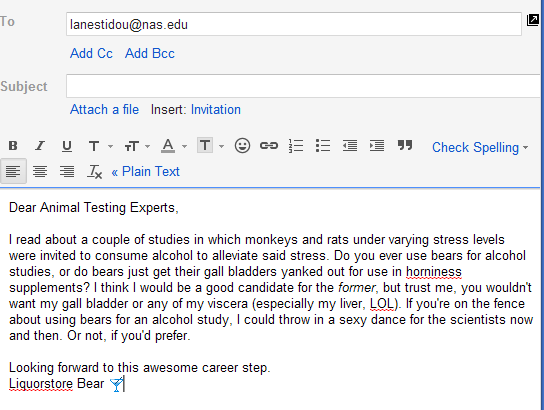
We definitely need more alcohol studies, using lots of different subjects, especially bears.

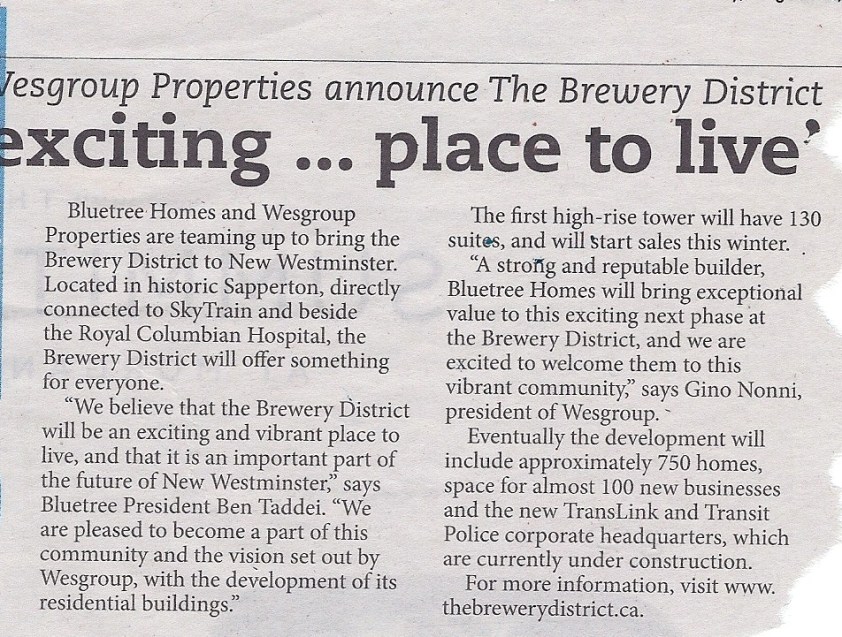
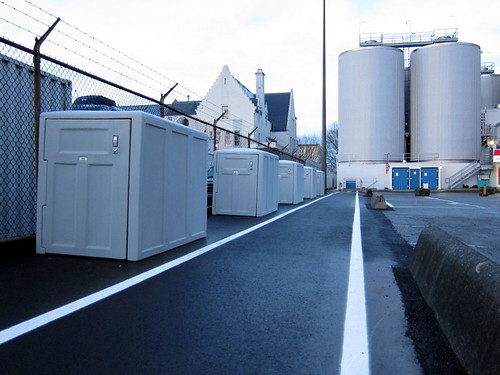 Where the hell is the so-called Brewery District? My first guess was the south foot of the Burrard Street Bridge, where Molson Canadian belches out yeasty-smelling effluent. I would have loved to live there, people. But it turns out that’s not the Brewery District; it’s just an area dominated by a giant macro brewery.
 The new marketer-spun Brewery District is in New Westminster. How could I not have known this was a particularly beer-oriented locale? (I think my parents really should have known, don’t you?) I mean, sure, the development’s not ready, and when it is, it’ll consist of little child-unfriendly high-rises, and we’d have to yank the kids out of school and across the city, but…beer. We’d be living the dream, my fellow inebriates.


 Liquorstore Bear